Pages

Showing posts with label data. Show all posts

Monday, August 03, 2026

Brazilian Farmers Tokenize Dairy Cows to Secure Loans: How Blockchain Is Transforming Agricultural Finance


Brazilian farmers
Brazilian farmers tokenize dairy cows

Brazilian Farmers Tokenize Dairy Cows to Secure Loans: How Blockchain Is Transforming Agricultural Finance

Blockchain technology has often been associated with cryptocurrencies like Bitcoin and Ethereum, but its real-world applications continue to expand into unexpected industries. One of the latest examples comes from Brazil, where dairy farmers have successfully used tokenized cows as collateral to obtain financing after traditional bank lending became increasingly difficult.

The groundbreaking project demonstrates how real-world asset (RWA) tokenization can help businesses unlock capital by converting physical assets into digitally verified financial instruments. While the idea of "tokenized cows" may sound futuristic, the technology behind it could significantly reshape agricultural lending and other industries that rely on physical assets.

What Happened?

Farmers in the Brazilian state of ParanĂ¡ recently became the first to tokenize dairy cattle and use them to secure financing on Brazil's B3 stock exchange.

In the pilot project, 10 dairy cows were converted into blockchain-backed digital assets, allowing farmers to obtain approximately $20,000 in credit secured by their livestock. The initiative was launched in response to tighter lending restrictions imposed by traditional banks, which have made it more difficult for many small agricultural businesses to obtain financing.

Rather than viewing the cows solely as farm animals, lenders were able to recognize them as digitally verified collateral supported by blockchain technology.

How Does Cow Tokenization Work?

The project was developed by Brazilian agricultural technology company Cowmed, which combines blockchain technology with artificial intelligence.

Each cow receives:

  • A unique encrypted digital identity
  • AI-powered smart collars that monitor health and activity
  • Real-time tracking information
  • Verified ownership records stored digitally

These smart collars continuously collect information about each animal's health, movement, and condition. The data helps create a trusted digital identity that lenders can verify without requiring frequent physical inspections.

Because every cow has its own digital record, it becomes much harder for borrowers to pledge the same asset multiple times—a common concern with traditional collateral.

Why Blockchain Matters

Traditional agricultural lending often involves significant paperwork, inspections, and uncertainty.

For lenders, livestock presents several challenges:

  • Animals can be sold.
  • Ownership records may not always be clear.
  • Health conditions can change quickly.
  • Physical inspections are costly and time-consuming.

Blockchain helps solve many of these issues by creating a permanent digital record that cannot easily be altered. Combined with AI monitoring, lenders gain greater confidence that the collateral remains healthy and still exists throughout the life of the loan.

This increased transparency can reduce lending risk while making financing more accessible for farmers.

Expanding Access to Credit

The pilot involved only ten cows, but its future potential is much larger.

Cowmed currently monitors approximately 100,000 dairy cows across roughly 1,000 farms, representing livestock valued at more than $395 million.

The company estimates that as many as 20% of its monitored network could eventually participate in tokenized financing programs. If adoption reaches that level, the system could unlock approximately $77.6 million in additional agricultural credit for farmers who may otherwise struggle to obtain loans through traditional banks.

For smaller agricultural operations, expanded access to financing could mean purchasing new equipment, expanding herds, improving infrastructure, or simply maintaining operations during difficult economic periods.

A Growing Trend: Real-World Asset Tokenization

The Brazilian dairy project is part of a much broader movement known as Real-World Asset (RWA) tokenization.

RWA tokenization involves converting ownership or value from physical assets into blockchain-based digital tokens. Assets being explored include:

  • Real estate
  • Government bonds
  • Private credit
  • Fine art
  • Precious metals
  • Commercial invoices
  • Agricultural products
  • Livestock

Supporters believe tokenization can make traditionally illiquid assets easier to finance, trade, and verify while reducing administrative costs and increasing transparency.

Financial institutions around the world have increasingly explored tokenization as blockchain infrastructure becomes more mature.

Benefits for Farmers and Lenders

For farmers, tokenized collateral offers several potential advantages:

  • Faster access to financing
  • Additional lending options beyond traditional banks
  • More efficient use of existing assets
  • Potentially lower borrowing costs

Meanwhile, lenders benefit from:

  • Improved collateral verification
  • Real-time monitoring of assets
  • Reduced fraud risk
  • Greater transparency
  • Better loan management

Instead of relying solely on paperwork and periodic inspections, lenders can monitor collateral throughout the life of the loan.

Challenges Still Remain

Despite its promise, tokenization is still in its early stages.

Several challenges remain before widespread adoption becomes possible:

  • Regulatory frameworks continue to evolve.
  • Blockchain standards differ across jurisdictions.
  • Farmers must adopt new technology.
  • Financial institutions need confidence in digital asset systems.
  • Market acceptance will take time.

As with any emerging financial technology, long-term success will depend on security, regulation, and broad industry adoption.

The Bigger Picture

The Brazilian dairy project illustrates how blockchain is moving beyond cryptocurrency speculation into solving real business problems.

Instead of creating digital assets out of thin air, tokenization connects blockchain with tangible, productive assets that already exist in the real economy. Whether those assets are office buildings, government bonds, or even dairy cows, the underlying goal remains the same: making capital more accessible while increasing transparency and reducing friction.

If successful, similar financing models could eventually expand beyond agriculture into manufacturing, transportation, construction, and countless other industries that rely on valuable physical assets.

As blockchain technology continues to mature, the tokenization of real-world assets may prove to be one of the industry's most transformative applications—bringing innovative financing solutions to businesses that have long struggled to access traditional credit.

Friday, July 17, 2026

Alabama and Americans Find Data Centers to be Unpopular While Tommy Tuberville Wants More Data Centers if Elected Governor

Tommy Tuberville (R - Auburn) wants more data center projects in Alabama, even though they are extremely unpopular in Alabama and across the United States. According to the National Conference of State Legislatures, 15 states are considering data center bans. He voiced his support for data center projects to the Alabama Sheriffs Association in Opelika, Alabama, on Monday.

Tommy Tuberville 17th Congress Portrait (public domain)

Tommy Tuberville is running against Democrat Doug Jones in the November general election. He is campaigning across the state of Alabama. He spoke in July 2026 to the Alabama Sheriffs Association in Opelika, Alabama.

Tommy Tuberville Wants More Data Centers in Alabama

In his speech to the Alabama Sheriffs Association, Tuberville said:

"We are going to have neighborhoods that are safe. Every city. Every county. Every place in Alabama. We're going to stand behind you 100%. We've got to do it, folks. We can not let the animals run the zoo. You're out there fighting with a short stick at times," Tuberville said during the speech. "Needing more money, needing more availability for your jails, needing more help from Mental Health, needing things that are really going to help you every day to make your job a little easier, and, you know, to get politics out of it. We don't need it to be political. We need it to be family. We've got 67 counties. We've got 67 sheriffs, and we need to help every dang one of you, but we need to give you the resources to get that done."

He continued, "Everybody asks, 'How do you do that?' I've talked to several groups — I've talked to fire chiefs, police chiefs. Here's how you do it: we've got to grow our state, but one of the big things that's bringing in a lot of tax money across this country is these data centers, and everybody has heard about them, you know, 'Big Tech' and all that. You can forget about doing away with it because it's coming. Everybody says, 'Well, AI is going to do away with jobs." It's going to create jobs as well as do away with jobs, but you've got to have data centers." 

"I think there's 27 states that have already said, 'Oh, we're not going to build data centers. We're not going to do that. It makes too much noise. It's going to ruin the climate.' Bull crap," Tuberville added. "I mean, they're listening to all this nonsense they see on social media that's coming from China because China does not want us to grow. The state of Alabama will grow. We're going to do data centers. It will help you tremendously. The tax money that comes from those things is unbelievable for schools, for law enforcement, for anything that's done. We're not the richest state in the country, but I'm telling you we're fixing to make a big move on it. I like winning championships. I like winning. I do not like losing, and we're not going to lose. A lot of that comes with being able to grow the state in the way that it needs to be grown to make sure that we're ahead of the times."

Source: 1819 News


Saturday, October 28, 2023

Capital One is Now Paying $190 Million in Class-Action Settlement to Eligible U.S. Residents for 2019 Data Breach

Capital One is paying out $190 million to customers who were affected by identity theft or fraud as a result of the 2019 Capital One data breach.

Capital One logo
Capital One by Maryland GovPics, CC BY 2.0 Deed

Capital One agreed to pay a $190 million settlement to customers who opted-in to the settlement by the deadline as a result of a 2019 data breach, and those payments are going out now through November 27, 2023.

If you don’t receive a payment by November 27, then you will not be receiving one.

Capital One 2019 Data Breach Class-Action Settlement

WGAL 8 News reported that emails started going out late last week (the third week of October 2023) to the victims of the 2019 Capital One data breach. The email states exactly how much each member is getting paid in the class-action settlement.

It can vary by how each victim was affected in terms of financial losses, time lost, and identity defense services used.

One person was paid $707 after receiving a confirmation email of payment from ‘noreply@epiqpay.com’ — which means that they opted-in to the settlement by the deadline.

What Happened in 2019?

The Washington Examiner reported that in 2019, a hacker gained access to the personal information of approximately 98 million Capital One users. Capital One announced in July 2019 that it was the victim of a criminal cyberattack on its systems.

Consumers brought numerous lawsuits against Capital One as a result of this data breach, and the lawsuits were overseen by Judge Anthony J. Trenga of the U.S. District Court for the Eastern District of Virginia

$190 Million Class-Action Settlement Agreed Upon

After a lengthy mediation process, both sides agreed to the settlement amount and the court granted final approval for a $190 million class-action settlement on September 13, 2022, to pay the out-of-pocket losses, lost time, identity defense services, account restoration services, and other expenses approved by the court.

The deadlines to file a claim with the Capital One Class Action Settlement were:

  • Filing a claim for lost time: September 30, 2022
  • Filing a claim for out-of-pocket losses: September 30, 2022
  • Filing a claim for identity defense services: September 30, 2022

If you filed a claim by the deadline, you are a “class member” and you would have received a notice with a Unique ID and PIN required to file a Claim Form.

If you are unsure if you are a class member, you can get confirmation by calling 1–855–604–1811 or emailing the plan administrator at:

If you joined this class action settlement by the deadline, payment will be sent by November 27, 2023, by check or digital payment.

Sources

Capital One Data Breach Class Action Settlement website.

Roche, Brian. “Victims paid in Capital One settlement.” WGAL 8 News. 25 October 2023.

Schilke, Rachel. “Class-action settlement: Capital One customers have less than a month to claim payment from $190 million settlement.” Washington Examiner. 24 October 2023.

Summary: This article is about the 2019 Capital One data breach and the customers affected by it, resulting in a Class-action Settlement.

Saturday, August 06, 2022

T-Mobile is Giving $350 Million in Free Money to Customers from Mass Arbitration; Here's How to Get it

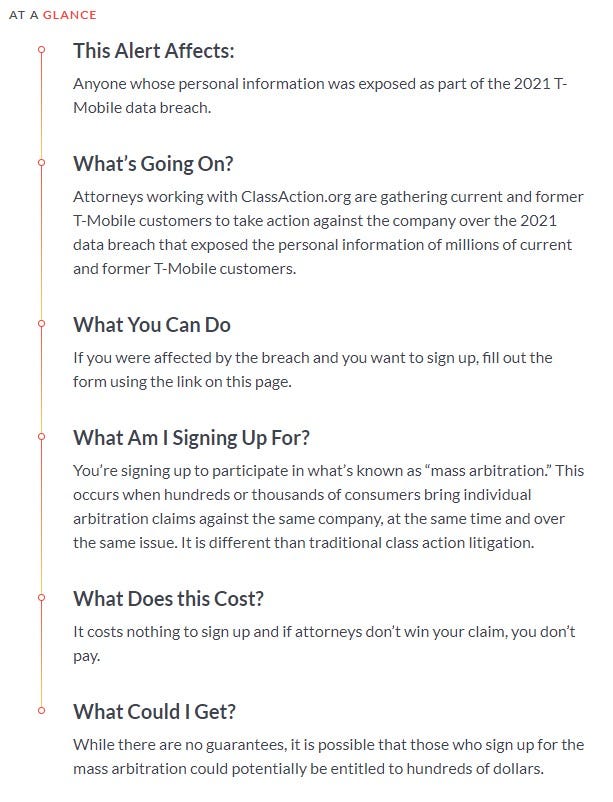
If you were a T-Mobile customer affected by the data breach in August 2021, you could be entitled to your share of the $35 million USD mass arbitration.

T-Mobile Data Breach Mass Arbitration

T-Mobile Customer Data was Exposed in a 2021 Data Breach

In2021, T-Mobile customer data was sold on criminal forums. T-Mobile claims that less than 1,000,000 customer accounts had their PIN #'s fully exposed, and between 40,000,000 to 100,000,000 users had partial account data stolen. (Source: TechCrunch)

Source: ClassAction.org

Attorneys are working with ClassAction.org to gather information from affected T-Mobile customers in the 2021 data breach. Directions are provided below in How to Participate in the T-Mobile Mass Arbitration.

Who was affected by the T-Mobile data breach?

Approximately 76.6 million U.S. residents that were T-Mobile customers in August 2021 were identified whose information was compromised in the data breach. (Source: TechCrunch)

How much is in the mass arbitration?

T-Mobile announced that $350,000,000 USD will be split among customers and will pay related lawyer fees for administering this mass arbitration, with an additional $150,000,000 to be spent internally "for data security and related technology to upgrade their information security protocols.

T-Mobile info (public domain) ClassAction.org

YouTube: "T-Mobile got hacked — This is what you need to do ASAP!"

                                          YouTube: Liron Segev

How to Participate in the T-Mobile Mass Arbitration

If you choose to sign up for mass arbitration, the law firm Milberg Coleman Bryson Phillips Grossman will represent you.

Here are the directions:

Step 1. Go here. Then answer the two questions regarding T-Mobile (see screenshot below).

Screenshot of survey for law firm Milberg Coleman Bryson Phillips Grossman page 1

Step 2. If you answer "Yes" to these questions, it will take you to the next page (see screenshot below) where you provide your contact info. The law firm Milberg Coleman Bryson Phillips Grossman will also take a fee from your share, which is one-third of your entitled settlement.

Screenshot for law firm Milberg Coleman Bryson Phillips Grossman page 2

Is it Free to sign up, or is there a Fee?

On the ClassAction.org site, it says:

"It costs nothing to sign up. The attorneys handling the mass arbitration will only get paid if they recover money on your behalf, and their payment will come as a percentage of your award. If they don't win your claim, you don't pay."

"While there are no guarantees, it is possible that those who sign up for the mass arbitration could potentially be entitled to hundreds of dollars."

Reader poll:

Have you been affected by the T-Mobile data breach? (Answer in the comments)

A. Yes, my data was exposed. B. No, I'm not a T-Mobile customer.

Sources

Coldewey, Devin. "T-Mobile will pay out $350M to customers in data breach settlement." TechCrunch. 22 July 2022.

"Legal Investigation: 2021 T-Mobile Data Breach." ClassAction.org Updated June 16, 2022

YouTube: Liron Segev. "T-Mobile got hacked — this is what you need to do ASAP!" Published: 25 August 2021.

Copyright notice

Follow or Subscribe!

If you have found this article interesting, you can receive my article to your Medium signup email by clicking here and clicking subscribe.

Sunday, April 17, 2022

$92 Million TikTok Settlement Payment and Class Action Lawsuit


TikTok Settlement payment
TikTok Settlement Payment


$92 Million TikTok Class Action Lawsuit Settlement

TikTok is facing the clock after an Illinois federal judge approved a $92 Million USD settlement for its users that filed class-action lawsuits. Anyone that filed to join this class action lawsuit before the deadline will receive a TikTok settlement payment.

TikTok Case over Unlawful Collection of Users' Biometric Data


The settlement case information:

In re: TikTok Inc. Consumer Privacy Litigation, Case No. 1:20-cv-04699, in the U.S. District Court for the Northern District of Illinois.

The Illinois federal judge believes that the proposed $92 million USD settlement payment sufficiently resolves the accusations that TikTok was collecting biometric data unlawfully. 

What will people get who filed claims against TikTok?

TikTok users that filed a claim in this $92 Million USD class action settlement will get an equal share in the settlement cash after administrative fees and costs have been taken out.

Who can file a claim, and when is the deadline and hearing date for the TikTok settlement?

People that qualify are considered "class members" and this includes TikTok users who are residents in the United States that used the TikTok app before September 20, 2021. Any class member that is also an Illinois resident may qualify for an increased amount of settlement payment, by as much as six times the amount of someone that is not an Illinois resident.

The deadline for the settlement payment is March 1, 2022. The final approval for this TikTok settlement payment will take place during the hearing currently scheduled on May 18, 2022.

How will I receive my TikTok cash settlement payment?

If you successfully submitted a claim form by the March 1, 2022 deadline, then you should expect to receive your cash payment via PayPal, Venom, a virtual prepaid card, or by a physical check in the mail. Your preferred payment method was provided on the settlement application.

What was the legal issue with TikTok privacy policies?

The litigation against TikTok involved their privacy policies. The claims were that TikTok unlawfully collected users' biometric and personal data in 2021. 

TikTok asserts that users waived their rights in the agreed-upon terms of service, or privacy policies, and have therefore done nothing wrong.

TikTok Privacy Policy Changed


TikTok agreed to stop collecting users' biometric data, geolocation, and GPS data with their app and storing this data outside the U.S. after the $92 million USD settlement payment from the class action lawsuit. TikTok revised its privacy policies.

TikTok was accused of sharing users' biometric data with the Chinese government, while TikTok denied this was taking place.

The class-action lawsuit is against TikTok and its predecessor app, Musical.ly.